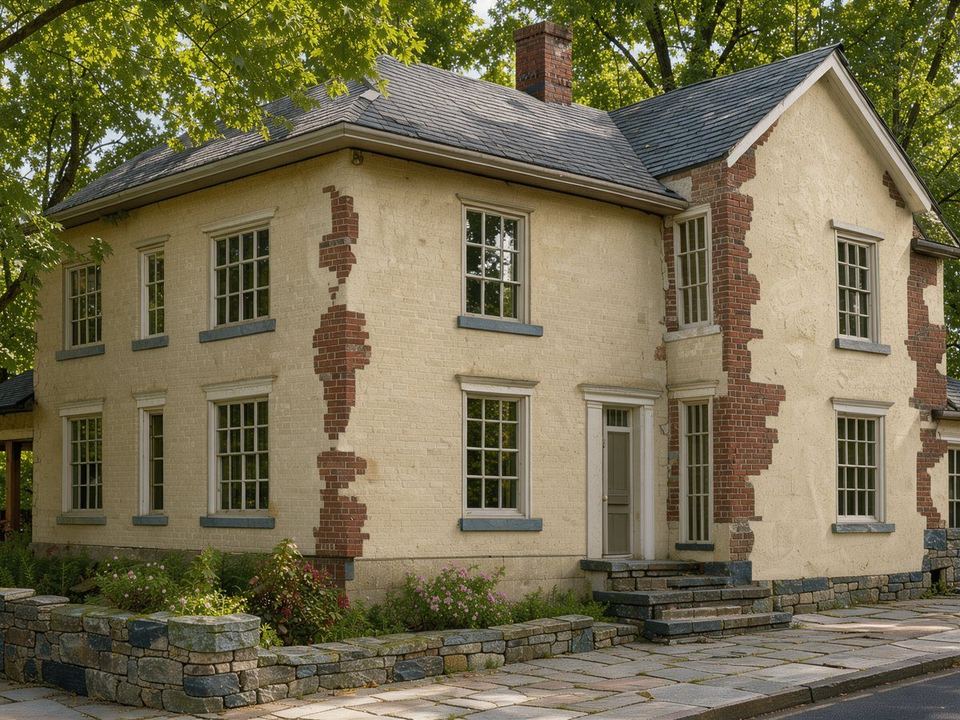
Why Stockade and Rondout masonry rejects hard cement
Walk down historic blocks in Kingston's Stockade District, along steep Rondout streets, or past stone and brick houses in Hurley, Marbletown and Rosendale, and you will spot the same scar: grey Portland cement patches curling away from softer cream or buff plaster, taking a crust of red brick or limestone with them. Builders before the mid-twentieth century laid masonry in soft lime or natural-cement mortar and coated exteriors with equally gentle, porous renders.
Modern Type S or straight Portland cement stucco cures several times harder than nineteenth-century kiln brick and passes very little water vapor. When indoor winter moisture or wind-driven rain migrates outward through an older solid wall and hits a dense cement patch, liquid water accumulates right behind that rigid skin. The first deep Ulster County freeze expands that trapped moisture, shearing either the patch or the historic brick face behind it.
How softer lime-rich plaster protects old brick and stone
Traditional exterior plaster works as a sacrificial, breathable cushion. Instead of locking moisture inside the structure, a lime-rich or high-lime cementitious mix has an open pore network that draws dampness out to the air by capillary action so the structural stone, brick or split wood lath stays dry. Just as important, softer binder chemistry yields slightly as thick masonry walls warm and cool across seasons rather than cracking along sharp stress lines.
Before selecting a repair mix, we examine broken edges to see what sits underneath—soft brick, rubble bluestone, hollow clay tile or riven wood lath—and judge the hardness and aggregate of the original base coats. We strip away loose plaster and any trapped Portland or elastomeric patches, repoint open mortar joints where needed, check bluestone window sills and Yankee gutters above the damage, and build new coats in compatible lifts. The same breathable mortar rules apply down along rubble-stone foundations and exposed chimneys, and on tall historic gables our crew erects supported pipe scaffolding so ladder rails never lean against fragile wood gutters or slate eaves. Where a house turns out to be mid-century wire lath and Portland stucco instead, our standard cement stucco repair process applies.
Matching historic sand grit and hand-floated textures
Old plaster owes its look to local washed sands and wood or sponge floats, not synthetic polymer beads troweled to a uniform factory swirl. Packing modern fine-sand acrylic patch compound into a coarse nineteenth-century wall leaves a flat, plastic-looking bullseye even after painting. We blend coarser masonry sands to match the exposed aggregate around weathered areas and finish patches with traditional float techniques. If an entire wall needs color unification afterward, we pair repairs with breathable mineral silicate or lime-compatible coatings rather than sealing the masonry; see stucco refinishing options.
Slower curing and tighter fall temperature limits
Lime-rich mortars gain strength partly through carbonation with air and cure more gradually than fast-setting Portland mixes. Fresh coats have to be misted and shielded from hot afternoon sun or dry wind so they do not chalk or craze prematurely, and they need stable mild weather well clear of autumn frost. While finish work requires at least 40 °F and rising with 24 frost-free hours—and historic lime work benefits from an earlier autumn cutoff—we inspect older homes and plan scopes all year.